
Aviation is one of the hardest sectors in the global economy to decarbonise. It produces approximately 165 million tonnes of CO₂ per year in Europe alone — and unlike road transport, it cannot simply switch to batteries. The energy density gap is unforgiving: jet fuel stores roughly 60 times more energy per kilogram than a modern lithium-ion battery pack. Short regional flights may electrify in the coming decades, but long-haul aviation — which drives the majority of the sector’s emissions — will depend on energy-dense liquid fuels for the foreseeable future.
That reality is why sustainable aviation fuel (SAF) has moved to the centre of aviation’s decarbonisation strategy, and why the EU’s ReFuelEU Aviation regulation mandates a minimum 70 per cent SAF blend by 2050 — including at least 35 per cent synthetic e-SAF produced from renewable energy. Yet today, SAF accounts for under one per cent of aviation fuel use, and synthetic e-SAF production capacity is a small fraction of what those mandates require.
SAFphyre exists to help close that gap.
The SAFphyre Approach
SAFphyre — Sustainable Aviation Fuel Production via High Temperature Electrolysis and an Integrated Fischer-Tropsch Reactor — is a four-year research and innovation project funded by the Clean Hydrogen Partnership under Horizon Europe. Its goal is to demonstrate an integrated production route that converts renewable electricity, water, and captured CO₂ directly into sustainable aviation fuel.
The process rests on two coupled technologies.
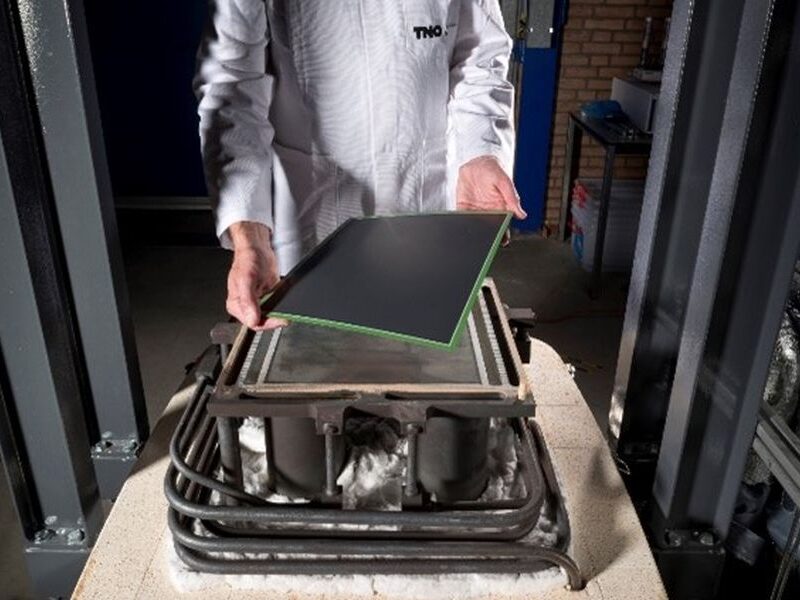
The first is solid oxide co-electrolysis (co-SOE). Conventional electrolysers split water into hydrogen and oxygen. Co-SOE goes further: operating at 700–900°C, it splits both steam and CO₂ simultaneously, producing syngas — a mixture of hydrogen and carbon monoxide — in a single electrochemical step. The high operating temperature is a feature, not a drawback: it lowers the electrical energy required, speeds up reaction kinetics, and allows the process to make use of heat from elsewhere in the system. The ratio of hydrogen to carbon monoxide in the syngas can also be tuned by adjusting the input mix, making the output adaptable to different downstream fuel targets.
The second is Fischer-Tropsch (FT) synthesis — a catalytic process, industrial since the 1920s, that converts syngas into liquid hydrocarbons. Optimised for the jet-range fraction, FT synthesis produces paraffinic fuel that is fully drop-in compatible with existing aircraft and fuelling infrastructure. No engine modifications required.
What makes SAFphyre distinctive is the integration between the two. The FT reactor releases heat as it operates; SAFphyre captures that heat to raise the steam the co-SOE process needs, substantially reducing external energy input. Unreacted gases from the FT reactor — methane, CO₂, and light hydrocarbons — are recycled back to the co-SOE inlet, targeting carbon utilisation above 95 percent. The result is a process that is not only efficient but genuinely carbon-circular: the CO₂ goes around, not up.
What the Project Will Deliver
Over 48 months, the SAFphyre consortium will:
Develop next-generation solid oxide cells. Multi-scale modelling of the degradation mechanisms that limit cell lifetime — carbon deposition and nickel migration — will inform new cell designs, manufactured and validated against a state-of-the-art baseline.
Prove durability at short-stack level. Next-generation cells will be tested over more than 3,000 hours of continuous co-electrolysis operation, targeting a degradation rate low enough to make the commercial case for co-SOE credible.
Demonstrate the integrated process at operational scale. A 25 kWe co-SOE stack coupled directly to a pilot Fischer-Tropsch reactor will run for over 4,000 hours, including at least 2,000 hours of constant full-load operation and more than 100 hot-standby and load modulation cycles — the operating conditions any commercial plant must handle.
Build the industrial-scale case. System modelling will extend the demonstrator results to configurations of 100 MW and beyond, with a full techno-economic analysis and life cycle assessment quantifying the cost and environmental performance of co-SOE-based SAF production across more than 30 European use cases.
The Consortium
SAFphyre brings together seven partners across five countries: TNO (Netherlands, coordinator), Topsoe (Denmark), Sasol (South Africa), CEA (France), EPFL (Switzerland), Aarhus University (Denmark), and Linq Consulting (United Kingdom). The consortium combines fundamental cell science, system-level modelling, industrial-scale Fischer-Tropsch and SOEC manufacturing expertise, and dedicated communications capability — the full chain needed to move a technology from laboratory understanding to a credible deployment pathway.
Follow the Project
SAFphyre runs from January 2026 to December 2029. Results will be shared here on the project website, through our bi-annual newsletter, and on the project’s LinkedIn page as the work packages begin to deliver data.
The technology to decarbonise long-haul aviation needs proving now. That is what SAFphyre is here to do.