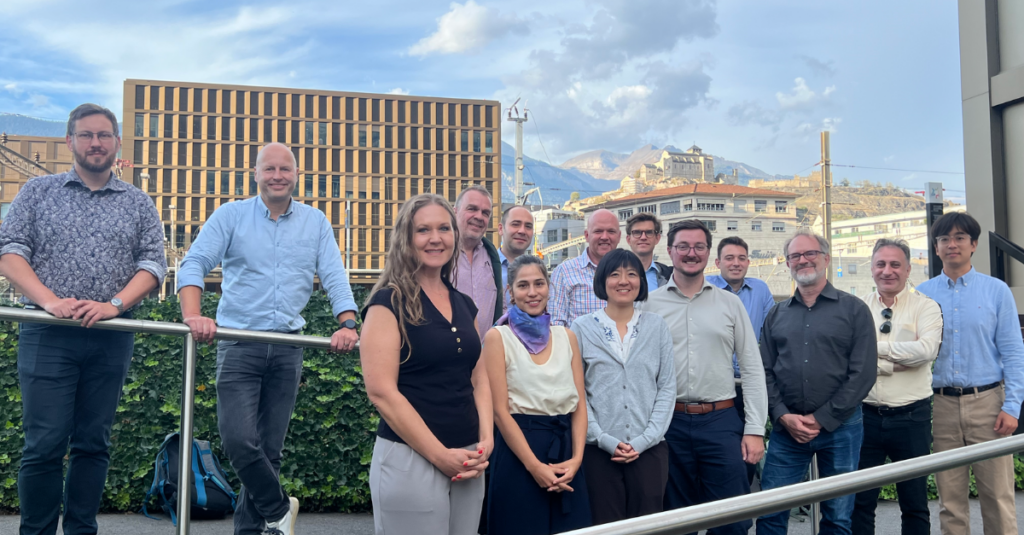
SAFphyre is officially underway. On 2–3 February 2026, representatives from all seven consortium partners gathered at TNO’s research facility in Petten, the Netherlands, to launch a four-year European project with a single ambitious goal: demonstrating that sustainable aviation fuel can be produced efficiently and at scale from renewable electricity, water, and captured CO₂.
Two Days to Set the Course for Four Years
The kick-off meeting brought together researchers, engineers, and communications specialists from TNO, Topsoe, Sasol, CEA, EPFL, Aarhus University, and Linq Consulting — a consortium spanning five countries and two continents.
Over two days, the partners aligned on the project’s technical objectives, work package plans, and delivery timelines. Discussions covered the full breadth of the project: from the harmonised testing protocols that will ensure cell and stack results remain comparable across three different laboratories, to the design requirements for the 25 kWe integrated demonstrator that stands at the heart of the project, to the communication and stakeholder engagement strategy that will carry SAFphyre’s results to the audiences best placed to act on them.
For a project of this complexity — combining fundamental cell science, system-level modelling, industrial-scale expertise, and a physical demonstration campaign — early alignment matters enormously. The decisions made in these first months, from operating point selection to testing protocols, will shape the quality and comparability of everything the project produces over the following four years.
What SAFphyre Will Do
SAFphyre (Sustainable Aviation Fuel Production via High Temperature Electrolysis and an Integrated Fischer-Tropsch Reactor) addresses one of the most pressing technology challenges in aviation decarbonisation: producing synthetic aviation fuel efficiently enough, and at low enough cost, to meet the EU’s regulatory mandates.
The project’s approach combines two technologies. Solid oxide co-electrolysis (co-SOE) converts renewable electricity, steam, and CO₂ into syngas — a mixture of hydrogen and carbon monoxide — in a single high-temperature electrochemical step. That syngas then feeds a Fischer-Tropsch (FT) reactor, where catalytic synthesis builds the jet-range hydrocarbons that constitute sustainable aviation fuel.
The integration between these two processes is where SAFphyre’s efficiency case lives. The FT reactor generates heat as it operates; SAFphyre captures that heat to generate the steam the co-SOE process requires, reducing external energy demand. Unreacted gases from the FT reactor are recycled back to the co-SOE inlet, targeting carbon utilisation above 95 percent.
Over the project’s 48 months, the consortium will develop and manufacture next-generation solid oxide cells, validate them over more than 3,000 hours of short-stack durability testing, and operate a fully integrated 25 kWe co-SOE + FT demonstrator for over 4,000 hours of steady-state and dynamic operation. Alongside the experimental campaign, system-level modelling will extend the results to industrial scale, evaluating configurations of 100 MW and beyond.
A Consortium Built for the Challenge
Each partner brings a distinct and essential capability. TNO, as coordinator, contributes solid oxide cell manufacturing and testing expertise. Topsoe supplies state-of-the-art SOEC cells and industrial manufacturing knowhow. Sasol brings decades of industrial Fischer-Tropsch experience and world-leading catalyst expertise. CEA contributes multi-scale cell modelling and short-stack testing. EPFL leads system simulation, techno-economic analysis, and life cycle assessment. Aarhus University operates the integrated demonstrator, and Linq Consulting leads dissemination and stakeholder engagement.
The project is funded by the Clean Hydrogen Partnership under Horizon Europe, with a contribution of €4.05 million (Grant Agreement No. 101251371).
What Comes Next
The project’s first phase is already in motion. Early work focuses on defining the use cases and operating points that will ground the experimental campaign, establishing harmonised testing protocols across the consortium’s laboratories, and characterising the baseline performance of state-of-the-art cells in co-electrolysis mode.